

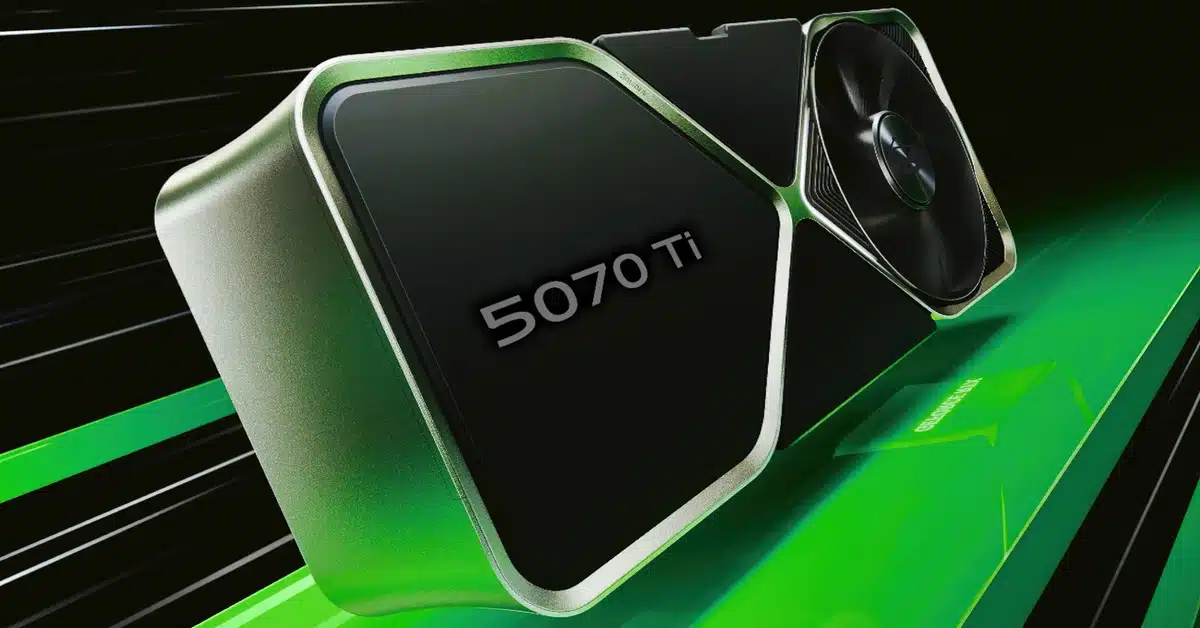
With the upcoming super refresh of the RTX 5000 series, NVIDIA is apparently not only planning upgrades for the RTX 5080 and 5070, but also a new model: the GeForce RTX 5070 Ti Super. Leaks suggest a graphics card that scores with a memory expansion and increased power consumption – an attractive offer for users who expect more performance than the regular 5070 Ti model but don’t want to go straight for the 5080.
- 24 GB GDDR7 memory – instead of the previous 16 GB
- Higher TDP of 350 watts – enables potentially higher clock rates
- Unchanged expansion of the GB203 GPU – same number of active units as the base model
- PCIe 5.0 connection and modern NVENC/NVDEC engines for content creators
Memory upgrade as a key argument
Probably the most significant difference to the regular RTX 5070 Ti is the expanded graphics memory: according to the leaker, 24 GB is now used instead of 16 GB GDDR7. This 50% increase in memory is in line with the current trend in the upper mid-range – similar to the RTX 5070 Super, which also has an increase in memory (18 GB instead of 12 GB). The use of 3 GB modules instead of the usual 2 GB modules makes this upgrade possible.
Especially modern games with high texture resolutions or complex ray tracing benefit massively from additional VRAM. The expanded memory is also a clear advantage for applications in AI, 3D rendering or workloads with multiple displays. This step should appeal to many users who felt limited by previous models – without wanting to switch to the significantly higher high-end class.
GeForce RTX 5070 Ti Super
PG147-SKU55
GB203-350-A1
8960FP32
256-bit GDDR7 24G 28Gbps
350W– kopite7kimi (@kopite7kimi) June 29, 2025
Technical basis remains largely unchanged
In contrast to the RTX 5070 Super, which is expected to be equipped with more shader clusters, the RTX 5070 Ti Super uses the same number of active processing units as its namesake without the “Super” suffix, according to the latest leak. This means: no expansion of the GB203 GPU, but a purely clock and memory-driven increase in performance.
However, the higher TDP of 350 watts (instead of 300 watts) opens up more leeway for the boost clock, which – depending on the thermal design of the partner cards – could well translate into measurable additional performance. The RTX 5070 Ti Super thus ranks below the 5080 Super, but remains above the upcoming 5070 Super in terms of performance.
The connection is via PCIe 5.0 ×16, which should be more than sufficient for future bandwidth requirements. The card is expected to be equipped with 2× NVENC (9th generation) and 2× NVDEC (6th generation) – ideal for content creators, streamers or AI-based video processing.
Table: Comparison RTX 5070 Ti vs. Ti Super
| feature | RTX 5070 Ti | RTX 5070 Ti Super |
|---|---|---|
| GPU | GB203 (shortened) | GB203 (shortened) |
| CUDA cores | 8960 FP32-ALUs | identical |
| VRAM | 16 GB GDDR7 | 24 GB GDDR7 (28 Gb/s) |
| Memory bandwidth | 896 GB/s | identical |
| TDP | 300 W | 350 W |
| Boost clock | ~2450 MHz | expected higher |
Conclusion: Promising mid-range upgrade with potential
The NVIDIA GeForce RTX 5070 Ti Super is clearly aimed at demanding users who want more memory and clock speed without having to go straight for an RTX 5080. Technically, it is based on familiar components, but supplements the central weak points of the original: memory and thermal headroom.
Price & availability: There is currently no official information. If NVIDIA adheres to the current super refresh schedule, a release could take place as early as the third quarter of 2025. In terms of price, the card is likely to be priced between the current RTX 5070 Ti (RRP: around €799) and the expected 5080 Super (over €1,000).


