


In March, Pioneer launched a triple version of an SSD for internal use – which hardly anyone in this country has noticed. In mid-October, however, according to Pioneer, this should change. High time the APS SE20Q times more exactly under the magnifying glass to take.
The Solid State Drive with the capacities 500 GB, 1 TB and 2 TB is available; we have the middle one of the three.
We took a closer look at the Pioneer SSD APS-SE20Q and ran it through our test system to see if the Japanese company could deliver the specified performance.
Technical data
| Capacities | 500 GB / 1 TB / 2TB |
| Interface | PCIe Gen3x4 NVMe 1.3 |
| Form factor | M.2 |
| Read/write | 3,400 MB/s / 3,000 MB/s |
| Flash type | NAND |
| Cache | SLC-Cache |
| Dimension | 22 x 80 mm |
| Weight | 10 g |
| Prices | 60.99 € / 109.99 € / 219.99 € |
The APS-SE20Q operates via a third-generation M.2 PCIe interface with four lanes and NVMe protocol 1.3 on the software side, promising a reading speed of up to 3,400 MB/s. The chewing-gum-sized SSD is said to provide the ideal conditions for playing games and transferring videos and photos.
In view of the ever-increasing demand for high speed, no matter which hardware component is involved, Pioneer has built an SLC cache into its APS-SE20Q. This enables the company to focus on fast reading and writing, but makes itself dependent on the SSD capacity that is currently left over. On the credit side, however, the lower power consumption should be mentioned. In addition, Pioneer uses both static and dynamic wear leveling in its latest internal SSD. This extends the life of the NAND flash, as writing and erasing is evenly distributed over the blocks.
In addition, the Pioneer APS-SE20Q SSD is also equipped with the Error-correcting Code (ECC), which can detect and simultaneously correct possible errors. This protects data from damage. And to prevent overheating of individual components, the APS-SE20Q throttles them down when necessary.
All in all, the Pioneer SSD comes with a neat package. To what extent the data also proves itself in practice, we have examined in detail with our test system.
Our test system
- MSI Z390I Gaming Edge AC Motherboard*
- Intel Core i5-9600K processor*
- 16 GB Corsair Vengeance RGB PRO 3200 RAM*
- MSI GeForce RTX 2070 Super Ventus GP OC graphics card*
- Corsair MP510 480GB SSD*
- Corsair SF450 power supply*
That’s what we measured
We used the usual suspicious benchmark programs ATTO Disk, AS SSD, CrystalDiskMark and HD Tune Pro.
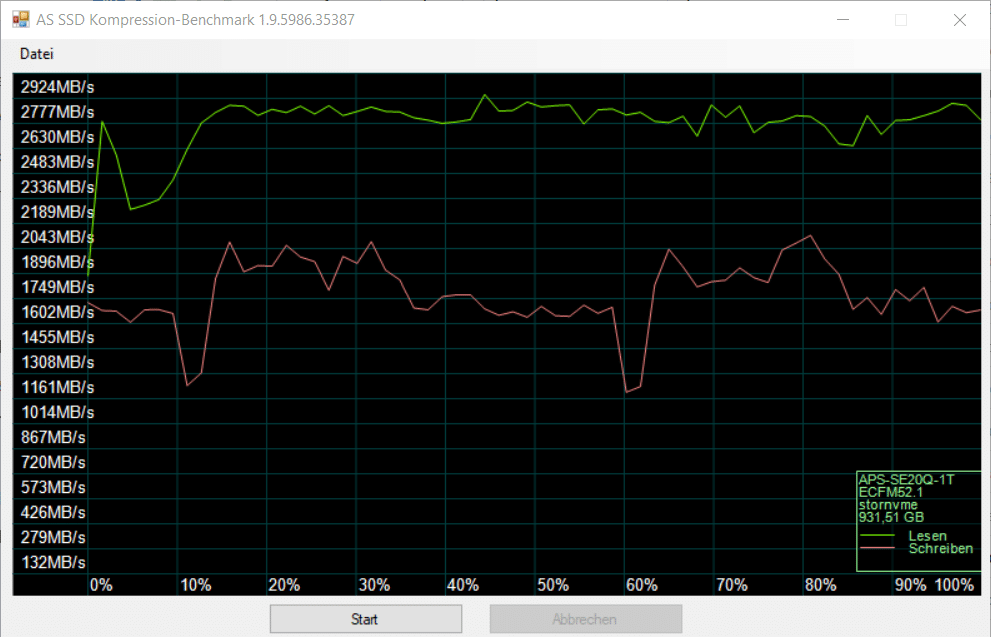
All results regarding sequential read and write came close to Pioneer’s descriptions. However, the even more important 4k or 4k-64Thrd readings are comparable to those of a lower-rated Western Digital Blue SN550 and therefore do not meet expectations. From the information provided by Pioneer, the APS-SE20Q should be higher than Western Digital’s and not equal to it.
On the other hand, the writing trumped when measuring the 4k-64Thrd benchmark and even came close to the sequential value. This can even be seen alongside a Samsung SSD 970 EVO. However, writing also showed one or two drops.
It should be noted that these figures and final results refer to the 1 TB variant. The reading and writing activities for the other two variants correspond to different specifications and results.
Conclusion on the Pioneer APS-SE20Q Test
In summary, Pioneer is on course for the upper performance class with the APS-SE20Q SSD. The promises of the Japanese electronics company are very promising. However, it remains to be seen to what extent it can keep up with Samsung, Crucial, WD and Co. in the long run.
The APS-SE20Q SSD is, however, already a step in the right direction and therefore recommended for a purchase, even if you have to dig a little deeper into your pocket. In the end the performance is right for the sum.

Fazit
The Pioneer APS-SE20Q offers decent performance at a good price and is therefore worth a recommendation.

